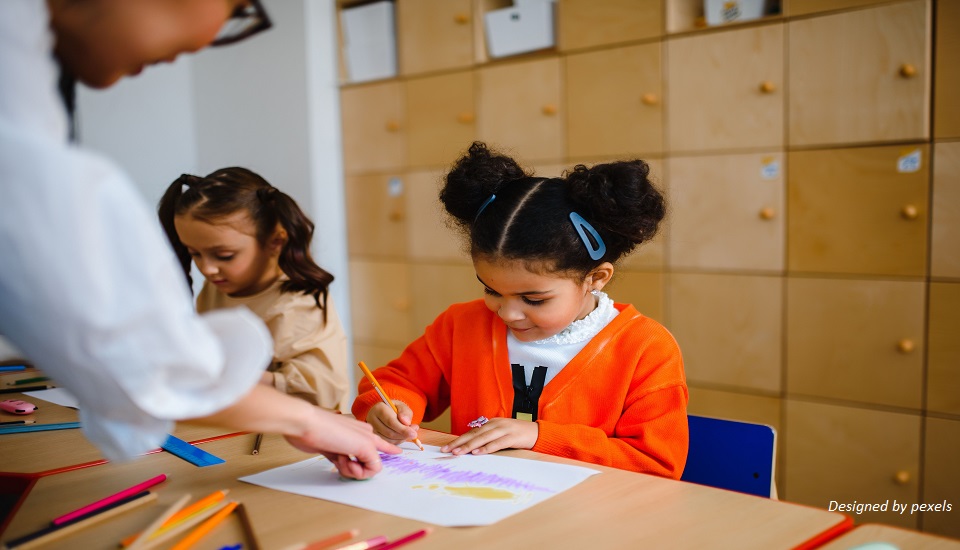
Walk into a Montessori classroom and something immediately feels different.
The teacher is not standing at the front of the room delivering a lesson. The children are not sitting in rows waiting to be told what to do next. Instead, children are moving, choosing, working independently, and collaborating in ways that look almost effortless.
But here is what most visitors miss entirely.
The teacher is working harder than anyone else in that room. Not louder. Not more visibly. But harder. They are watching. They are tracking. They are mentally recording dozens of small data points about every child in the space, all while appearing, to the untrained eye, to be simply present.
That capacity to observe with purpose and act on what is seen is not a personality trait. It is a professional skill. And it is becoming one of the most discussed and debated competencies in Montessori education today.
For anyone exploring an Online Diploma in Montessori or considering deepening their early years practice, understanding why observation sits at the centre of everything is a useful place to start.
What Dr. Maria Montessori Actually Said About Observation
This is not a modern management concept retrofitted onto an old philosophy. Observation was central to Montessori's original method from the very beginning.
Dr. Maria Montessori was, before she was an educator, a scientist. She approached children the way a researcher approaches a subject: with careful, systematic, non-interfering attention. Her entire method was built on what she observed children doing when they were given freedom, appropriate materials, and a prepared environment.
She wrote explicitly about the role of the educator as an observer. In her view, a teacher who intervenes unnecessarily, who directs when the child is managing, or who moves on before the child is ready, is not helping. They are disrupting a process that observation would have revealed was already working.
Her instruction to educators was essentially this: watch before you act. And then watch some more.
That principle has not changed. What has changed is the environment Montessori educators are now working in, and the expectations placed on them to document, evidence, and respond to what they observe with professional precision.
Why Observation in a Montessori Classroom Is More Complex Than It Looks
In a traditional classroom, assessment tends to happen at defined points. A test, a worksheet, a formal evaluation. The rest of the time, teaching follows a predetermined plan.
In a Montessori setting, assessment is continuous. It happens in real time, through observation, and it directly shapes what happens next for each individual child.
This makes the skill of observation genuinely demanding. A Montessori educator observing effectively is simultaneously:
- Tracking which materials each child is working with and for how long
- Noticing whether a child is genuinely concentrating or simply going through the motions
- Identifying when a child is ready to move to the next level of challenge
- Spotting social dynamics that may be affecting a child's engagement
- Recognising early signs of frustration, disengagement, or developmental difficulty
- Distinguishing between a child who needs space and a child who needs support
None of this is written on a schedule. It is read from the child, in the moment, through observation.
Getting it wrong has consequences. Moving a child on too quickly undermines their confidence and creates gaps in understanding. Leaving a child too long on material they have already mastered creates boredom and disengagement. Both outcomes are observable. Both are preventable when observation skills are strong.
The Three Distinct Types of Observation Montessori Educators Need to Master
Not all observation in a Montessori setting serves the same purpose. Experienced educators typically work across three distinct modes, often shifting between them within a single session.
1. Scanning Observation
A broad, sweeping awareness of the whole classroom environment. Who is settled? Who is moving around without purpose? Are there social tensions building in a particular corner? Is the noise level indicating productive concentration or escalating distraction?
Scanning observation is the baseline. It keeps the classroom functioning and allows the educator to identify where attention may be needed before a situation develops.
2. Focused Observation
Close attention directed at a specific child or small group over a sustained period. This is where developmental insight is gathered. How does this child approach a new material? Do they read the instructions first or dive in? How do they respond to difficulty? Do they persist, seek help, or quietly abandon the task?
Focused observation generates the detailed understanding of individual children that makes personalised learning genuinely possible in a Montessori setting.
3. Reflective Observation
This happens away from the classroom, when the educator reviews their recorded observations and looks for patterns. Has a particular child been avoiding certain materials for several weeks? Is there a consistent time of day when concentration dips across the group? Are certain children consistently choosing to work alone when peer collaboration might serve their development better?
Reflective observation connects daily detail to longer-term developmental understanding. It is the stage where observation becomes genuine assessment.
Why Documentation Makes Observation Professionally Credible
Observation without documentation is valuable in the moment but fragile over time. Memory is selective. Patterns are difficult to spot without a record. And in a setting where multiple children are developing simultaneously, the details of any individual child's progress are quickly displaced by the volume of daily experience.
Montessori educators who observe effectively record what they see in formats that allow for review, reflection, and, where necessary, communication with parents or support professionals.
Good observational documentation in a Montessori setting typically includes:
- The date, time, and context of the observation
- What the child was doing and for how long
- The specific materials involved and how the child engaged with them
- Any language used by the child during the activity
- The child's emotional state and social context
- What the observation suggests about readiness, understanding, or support needs
This kind of record is not bureaucratic overhead. It is the evidence base that makes personalised planning possible, and it is what allows an educator to have a genuinely informed conversation with a parent about their child's development rather than offering general impressions.
How Strong Observation Skills Change Outcomes for Children
The practical difference that skilled observation makes to children's experience in a Montessori environment is significant.
- A child who is silently struggling with a concept but not communicating it verbally will be identified sooner by an observant educator. The frustration is visible in how they handle the material, how frequently they return to it, and how their body language shifts when they encounter the difficulty.
- A child who has mastered a skill and is ready for the next challenge will move forward more quickly when an educator's observation is sharp enough to catch readiness as it emerges, rather than waiting for a formal assessment point.
- A child whose social development needs attention, perhaps one who is consistently excluded from group activities or who is dominating interactions in ways that are limiting their own learning, will receive timely and appropriate support when the educator is genuinely watching.
In each of these cases, the observation comes before the intervention. And the quality of the intervention is directly dependent on the quality of the observation that preceded it.
Why Observation Skills Are Now Being Taught More Explicitly in Montessori Training
Historically, observation was treated as something good educators naturally developed over time, through experience in the classroom and mentorship from more experienced colleagues.
That approach is not wrong. Experience absolutely deepens observational skill. But relying on experience alone means that the skill develops unevenly, and that educators who do not have access to strong mentorship may spend years in practice without developing the systematic, reflective observation capacity that genuinely transforms their teaching.
The field has shifted. Observation is now increasingly taught as a formal component of Montessori educator preparation, with structured frameworks, practised techniques, and explicit attention to documentation and reflective practice.
This shift reflects a broader recognition that the outcomes children achieve in Montessori settings are directly linked to the quality of the educator's observational practice. It is not enough to prepare the environment and trust the method. The educator's ability to read what the environment reveals about each child is the mechanism through which the method actually works.
What This Means for Educators Considering Montessori Qualification
If you are thinking about entering Montessori education, or deepening your current practice, the quality of observational training within your chosen program is worth investigating carefully.
Look specifically for programs that:
- Include explicit instruction in observational techniques, not just general classroom management
- Require documented observation practice as part of assessed coursework
- Cover reflective practice frameworks that connect observation to planning and response
- Include supervised observation in authentic Montessori settings where possible
An International Teaching Diploma Online for Teachers that incorporates structured observation training as a core component is not simply adding a useful extra. It is building the foundational professional skill that makes everything else in Montessori practice possible.
The method only works when the educator can read what the children are showing them. That reading is observation. And it is a learnable, teachable, assessable professional skill.
The Bottom Line
Observation is not the quiet background activity it appears to be in a Montessori classroom. It is the engine that drives everything: the planning, the pacing, the individual support, and the environment design.
As the Montessori approach continues to grow globally, and as parent and institutional expectations around evidenced, personalised learning increase, the educator who observes with precision and reflects with depth is the one who delivers on the method's genuine promise.
For educators building their practice from the ground up, a well-structured Online Diploma in Montessori that places observation at the centre of its curriculum is the foundation worth investing in. Because in a Montessori classroom, what you see in the children, and what you do with what you see, is what teaching actually is.
Frequently Asked Questions (FAQs)
Q1. Why is observation important in Montessori education?
Observation allows Montessori educators to understand each child’s concentration, readiness, engagement, social interactions, and support needs. This information helps educators decide when to intervene, when to provide a new challenge, and when to allow the child to continue independently.
Q2. What are the different types of observation used by Montessori educators?
The blog identifies three distinct forms: scanning observation, which provides awareness of the whole classroom; focused observation, which examines an individual child or small group closely; and reflective observation, which involves reviewing recorded observations to identify longer-term patterns.
Q3. Why is documentation important when observing children?
Documentation creates a reliable record that can be reviewed over time. It helps educators identify patterns, inform personalised planning, track development, and communicate more accurately with parents or other professionals.
Q4. Can observation skills be learned and developed?
Yes. While classroom experience can strengthen observation, the blog emphasises that observation can also be explicitly taught through structured techniques, documented practice, reflective frameworks, and supervised observation in authentic Montessori settings.
Q5. What should educators look for when choosing Montessori training?
Educators should look for programmes that include explicit observation techniques, documented observation practice, reflective approaches connecting observation to planning, and supervised observation opportunities where possible.
Q6. How can an Online Diploma in Montessori support observation skills?
An Online Diploma in Montessori can provide structured preparation in Montessori principles and observation practices, helping educators develop a more systematic approach to understanding children and using observations to inform their teaching.
Written By : Abhishek