
Imagine a five-year-old walking into a classroom.
She chooses her own work. Settles into quiet concentration. No instruction given. No gold star promised.
Twenty minutes later, she's mastered a concept her older brother struggled with in Grade 2.
Her teacher hasn't said a word. She's been watching from across the room, taking notes.
That teacher didn't learn to teach this way by accident. She went through something that changed how she sees children entirely.
And increasingly?
That transformation is happening right here in Kolkata.
Why Global Demand for Qualified Montessori Teachers Is at an All-Time High
Parents and schools worldwide are done with one-size-fits-all education. The pandemic made that clear.
When children were home, away from rote schedules and exam pressure, many of them thrived in child-led environments. Parents noticed. Schools noticed. And the conversation around early childhood education changed permanently.
UNESCO and UNICEF have both pointed to Montessori principles as directly aligned with 21st-century skills:
- Independent thinking
- Intrinsic motivation
- Mixed-age, collaborative learning
- Self-directed problem solving
The demand for qualified Montessori educators has surged. But here's the uncomfortable truth, truly trained Montessori educators are scarce, and India's training ecosystem is still catching up.
Why Kolkata Is Becoming a Serious Hub for Montessori Teacher Training in India
Bengaluru and Mumbai get most of the attention. But Kolkata has been quietly building something significant, and the numbers back it up.
What the data says:
- Montessori schools and student enrolments across India have grown by over 50% since 2016.
- Kolkata alone has 845+ Montessori-linked early education centres listed in directories.
- India now ranks among the top four countries globally for government-funded Montessori programs, alongside the US, Thailand, and the Netherlands.
- India's NEP 2020 directly prioritizes Early Childhood Care and Education in ways that align with Montessori's core vision.
Why Kolkata specifically?
The city's intellectual roots run deep. Tagore had already founded "Tagore-Montessori" schools by 1929, including at Shantiniketan, and Indian interest in the method was formally represented at the International Congress that same year.
That legacy hasn't faded. Combined with NEP 2020 alignment and growing AMI and AMS institutional interest in India, Kolkata is an underrated but genuinely important centre for Montessori teacher training today.
What International Montessori Certification Actually Requires from a Teacher
"Global standards" can sound like marketing language. In the Montessori world, it means something very specific.
Here are the five core competencies every properly trained Montessori educator must demonstrate:
1. Child Development Theory
- Understanding sensitive periods, the absorbent mind, and the four planes of development
- Rooted in Montessori's original observations, updated with modern neuroscience
- Non-negotiable, this is the philosophical foundation that everything else builds on
2. Prepared Environment Design
- Every shelf placement carries pedagogical intent
- Every material choice has a developmental reason
- The classroom itself is the teacher, and a trained educator knows how to build it
3. Observation as a Professional Skill
- Step back before intervening: Watch, Record, Understand
- Counterintuitive in instruction-heavy cultures, but central to the method
- Arguably, the most underappreciated competency in Montessori training
4. Individualized Planning
- Moving away from whole-class instruction
- Understanding where each child is in their unique developmental journey
- Planning that follows the child, not the syllabus calendar
5. Materials Mastery
- From the Pink Tower to the Golden Beads
- Not just how to present materials, but why they work neurologically and developmentally
- Presentation technique is only the surface; understanding is the depth
These aren't cosmetic additions. They represent a fundamentally different philosophy of what education is actually for.
What Montessori Training Actually Does to the Way You Think as a Teacher
Ask educators who have completed serious Montessori training in Kolkata what changed most.
The answer is almost never the materials.
It's always the philosophy.
Most teachers enter training having spent years, sometimes decades, in instruction-heavy, outcome-focused classrooms. Montessori training asks something difficult of them:
Rethink everything-
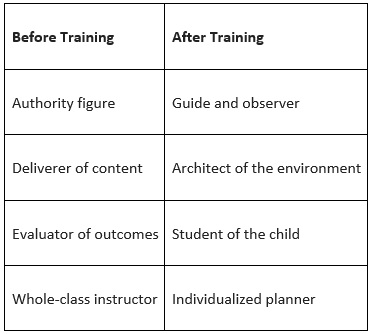
This isn't just professional development. For many, it's deeply personal, surfacing questions about how they were taught, what they believe children are actually capable of, and what education is ultimately for.
That kind of shift doesn't happen in a weekend workshop. It takes sustained engagement, reflection, and the right community around you.
What Montessori Schools in Kolkata and Across India Are Actually Looking for When Hiring
The hiring bar is rising. Montessori schools across Kolkata and Indian metros have grown fast and so have their standards.
What schools want from candidates today:
- A clear, demonstrable understanding of Montessori philosophy — not surface familiarity
- Proven ability to design and maintain a prepared environment
- Authentic observation skills and experience with individualized planning
- Comfort working with mixed-age groups
- Cultural sensitivity — the ability to honor a child's home environment within the Montessori framework
What's changed in the hiring process:
Many schools now include:
- Teaching demonstrations (not just interview rounds)
- Portfolio reviews showing real classroom work
- Practical assessments of material presentations
A Montessori Teacher Training Courses in Kolkata certificate opens the door. What you actually learned determines whether you stay in the room.
How to Choose the Right Montessori Certification Program in India?
The term "Montessori" is not legally protected. Anyone can call their course a "Montessori program." That makes choosing carefully essential, because the quality of your training shapes every child you will ever teach.
Here is what genuinely separates a credible program from a certificate mill.
1. Does the Program Offer a Structured Learning Pathway?
A serious institution offers progression. Not a single course that fits everyone regardless of experience or career goal.
Look for programs that offer distinct levels, something like a foundational certificate for those entering the field, a diploma for educators ready to go deeper, and a postgraduate qualification for those pursuing advanced specialisation in areas like classroom management or education leadership.
The best programs are also flexible enough to be pursued online or through distance learning, without compromising on depth. For working teachers in Kolkata and across India, that flexibility isn't a bonus. It is often the only way training is possible at all.
Some well-regarded institutions in Asia now offer Montessori programs ranging from 60-hour certificates up to 240-hour postgraduate diplomas, each designed for a different career stage, all accessible remotely.
2. Is the Accreditation Real (or Just a Logo on a Website)?
This is where many courses fall short. Accreditation matters because it tells you the program has been independently evaluated against defined quality standards.
When assessing a program, look for:
- Recognition by international quality assurance bodies, not just self-certification
- Endorsement from established education networks in the UK, Europe, or globally
- Institutional membership in recognized Montessori bodies, such as Montessori Europe
- Affiliation with organizations like Childhood Education International
A program with multiple, independently verified accreditations is a program that has invited scrutiny — and passed it. That is a meaningful signal.
3. Will the Certificate Actually Be Recognized When You Apply for Jobs?
A certificate is only as valuable as its recognition in the real world.
Ask directly: is this qualification accepted by schools internationally? Does it open doors in the Middle East, Southeast Asia, or Europe, not just locally?
Increasingly, Indian educators are seeking opportunities beyond their home city. A globally recognized Montessori qualification from a credible institution makes that possible. A certificate from an unverified provider often does not.
4. Does the Program Fit Around Your Existing Teaching Life?
Most working educators cannot pause their careers for full-time study.
A well-designed online Montessori teacher training course should offer:
- Genuine flexibility: Online and distance learning modes that work around teaching schedules
- Fast-track options for those who can commit more time
- Ongoing tutor support, not just self-study materials left to navigate alone
- Video lectures and live interaction, not just downloadable PDFs
If a program claims to be flexible but offers no real support structure, that flexibility is an illusion. Look for programs where support is built in — not an afterthought.
5. Is There Evidence of Real Institutional Credibility Over Time?
Anyone can build a course. Fewer institutions can demonstrate sustained credibility across multiple countries and years.
Ask these questions before enrolling anywhere:
- How long has this institution been training Montessori educators?
- Do they have alumni you can speak to directly?
- Are they recognized across Asia and internationally — or only within one country?
- Do they have academic collaborations with established European or global teacher training bodies?
Institutions like Asian College of Teachers (ACT) with a long track record of producing working Montessori educators, across diverse classrooms internationally tend to offer training that holds up in the real world. That track record is worth investigating before you commit.
Why Quality Montessori Teacher Training Matters?
There is something worth saying here that goes beyond hiring prospects and salary increments. India is home to over 250 million children in the 0–6 age group — the precise window that Montessori education is designed to serve. The quality of early childhood education these children receive will shape cognitive development, social-emotional resilience, and lifelong learning attitudes in ways that no later intervention can fully replicate.
Kolkata's growing ecosystem of Montessori teacher training isn't just about producing more certified educators. It is about building a generation of adults who understand children differently, more respectfully, more patiently, more scientifically. That is a quiet revolution. And it starts in a training room, with someone deciding to learn differently so their students can learn freely.
The Bottom Line
The convergence of global Montessori standards with locally grounded, contextually intelligent training is producing educators who are genuinely prepared for the classrooms of today and tomorrow. Whether accessed through a rigorous in-person program or a well-structured Montessori teacher training course in Kolkata, the opportunity to transform your practice and the lives of the children you teach has never been more within reach.
The question is simply this: are you ready to become the kind of teacher the next generation actually needs?
Frequently Asked Questions (FAQs)
1. Why is Montessori teacher training important today?
It equips educators with skills in child-led learning, observation, and individualized teaching, key to modern classrooms.
2. Is Montessori teacher training in Kolkata globally recognized?
Yes, many programs in Kolkata align with international standards and offer certifications accepted by schools worldwide.
3. What skills do Montessori training programs develop?
They focus on child development, classroom environment design, observation skills, and hands-on teaching methods.
4. Can I pursue Montessori training online?
Yes, flexible options like an Online Montessori Teacher Training Course, allow working professionals to upskill without leaving their jobs.
5. How do I choose the right Montessori training program?
Look for a structured curriculum, valid accreditation, global recognition, and practical teaching exposure.
Written By : Abhishek